

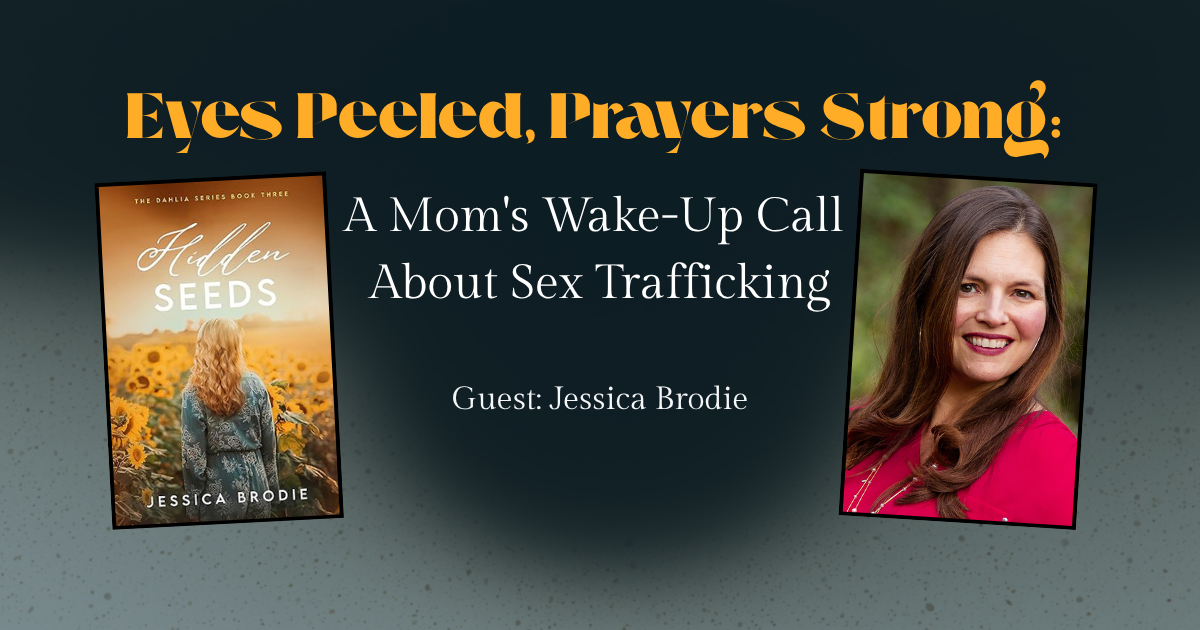
I’m excited to welcome Jessica Brodie back to Hopeful Mom. Jessica’s passionate about educating parents on mental health issues and the sex trafficking trade. She’s done her homework and wrote about trafficking in her newest novel, Hidden Seeds. Keep reading for a sneak peek into the book as well as helpful information to keep our kids from getting caught in a potential trafficking situation.
I thought sex trafficking involved women—or men—being violently kidnapped and coerced, or lured into trafficking through addiction.
What I didn’t realize until far too recently was that trafficking usually starts subtly, and right here in our neighborhoods, with young kids who could live next door. Both girls and boys are brought in through a gradual process called “grooming” that preys on their emotional and sometimes physical needs.
As the mom of four teens, I was horrified to learn how deviously calculating and orchestrated the trafficking system was in recruiting kids—and how easily it can happen.
Often grooming starts innocently. Traffickers might pose as a romantic partner, showering them with gifts and attention, gaining their trust. Or they entice their victims online, using a fake identity and photo to pretend to be far younger—all while gathering information to manipulate. Sometimes they seek vulnerabilities, like homelessness, poverty, abuse, or social isolation, offering solutions that foster dependency on the trafficker.
Others post ads for jobs like modeling or nannying, sometimes in a foreign country. When the victim arrives for their “job,” their documents are taken away and they’re forced into the sex trade.
And once they’re in, traffickers use drugs and other ways to control them, keeping them there with little effort.
In my latest novel, Hidden Seeds, one of the protagonists is a woman named Laney Ricks, who was lured into trafficking when she was thirteen. Now in her early twenties, she’s escaped The Life, as it’s called, and is trying her hardest to raise her four-year-old daughter under a new identity. For Laney, the only child of a single mother, her grooming started after her mom died, and she began helping at her stepdad’s bar. A young man befriended her, made her feel special, and ultimately convinced her to run away with him—and when money got tight, it wasn’t too hard to convince her to sell her body to keep them afloat. Soon, she was so fogged out on substances that she didn’t even care how bad her situation had become. It was only after she went to jail and discovered she was pregnant that she realized she wanted out.
In the novel, Laney gets hired at a brand-new art shop run by Natalie Motts, whose younger sister Hayley has started displaying troubling behavior, hiding texts and locking her phone. When Hayley goes missing and signs point to a local trafficking ring, Laney and Natalie team up to find Hayley before it’s too late.
Like me, Natalie and her parents were naïve about sex trafficking and how quickly grooming can progress.
Here’s an excerpt from when Natalie gets a return call from the local trafficking coalition, hoping they can partner with police to find her sister.
Her purse buzzed, and she jumped, realizing someone was calling her cell phone. Please, be Hayley, she begged silently.
Instead, it was the human trafficking coalition.
“I’m Ana Montoya,” the woman told her, explaining how they worked and how they could help. “Tell me everything you know.”
She did, from the bracelet and Laney to the red sports car.
“It used to be men doing most of the grooming, but these days, the women are just as bad.”
“Grooming?”
“It’s psychological mostly, like dangling a carrot in front of someone, whether that’s expensive gifts or the promise of a new lifestyle—a boyfriend, a group of new friends, or a big dream come true. Did your sister get any fancy gifts recently?”
Natalie remembered the sparkly H necklace, mentioned that, plus the rift between Hayley and her friends over the summer. “Oh, and manicures.”
Grooming, indeed.
“Divide and isolate. Like how wolves separate sheep from the pack, then close in for the kill.”
Natalie shivered, thinking of Hayley as some lone sheep, preyed upon. Vulnerable. Alone.
“The good news is we’ve got lots of resources,” Ana told her.
Natalie told her about the screenname they discovered last night, and the girl she’d tagged in those posts.
Ana promised to get back with her as soon as she could.
“For now, just keep your phone with you, your eyes peeled, and your prayers strong.”
I wrote this story because I needed to understand it—and because I believe stories can crack open our hearts in ways statistics and headlines can’t.
Hidden Seeds is fiction, but Laney and Hayley’s stories play out in real life every single day—in our schools, our neighborhoods, and our social media feeds. The best thing we can do is exactly what Ana told Natalie: keep our eyes peeled and our prayers strong.
Talk to your kids. Ask uncomfortable questions. And if something feels off, trust that instinct.
Awareness is the first line of defense, and it starts at home.
Subscribe to Hopeful Mom for two FREE PDF downloads and blog post updates. Check out the About page and all the resources available.
About the author

Jessica Brodie
Amazon bestselling novelist Jessica Brodie is an award-winning author and journalist with thousands of articles to her name and a huge heart for people and their inspiring redemption stories. The author of the Christian contemporary/women’s fiction Dahlia Series (The Memory Garden, Tangled Roots, andHidden Seeds), she holds a master’s in English and a bachelor’s in communications. A native of Miami, Florida, she now makes her home in South Carolina with her husband Matt, four children, three cats, and one giant German Shepherd. Find her atJessicaBrodie.com. Her novels are available on Amazon at https://www.amazon.com/dp/B0D3ZX4TF1 and from other major book retailers.